Portrait of Armand Asnani
Hey, I'm Armand.

Great software is invisible.

I build software you can use without even thinking. I have worked at large companies like Traveloka and at startups, so I know how to right-size software to what you actually need, and I train your team to run whatever I build.

What I offer: AI assistants and agents, connectors that put your existing tools inside Claude or ChatGPT, websites and web apps, custom software and MVPs, and advice on AI strategy and training.

  • Software engineer for 7+ years
  • M.S. in Computer Science
  • Currently at a bleeding-edge enterprise application GenAI startup in Southeast Asia

Services

Right-sized builds and advice, shaped with you along the way.

How I work with you

I iterate closely with you, so the result fits your needs.

Your feedback and my judgment finish it.

01

AI assistants

  • Built to help your users and ease the load on your support team
  • Grounded in your own content, with guardrails and honest fallbacks
  • Monitoring and analytics included, so you can see usage, answer quality and spend
  • Cost controls and right-sizing, so you do not overpay
  • Done well, they reduce support burden, improve the user experience and cut costs
The evidence behind this approach
from USD 2,000
02

Custom agents and automation

  • Cloud agents that automate your workflows without a big bill
  • Built on any LLM, with monitoring, evaluation and continuous improvement
  • Cost controls and usage analytics, so spend stays predictable
  • Also standard automation with tools like n8n when that is all you need
The evidence behind this approach
Custom quoteAfter a free discovery call
03

AI enablement

  • Your team already has Claude, ChatGPT or a similar assistant; I connect it to the tools and workflows you already run, using the open MCP standard
  • People can look things up and get work done from the assistant they already have open
  • No new app to buy or learn
  • Access is controlled per person, with usage logging, and each connector is sized to the job
The evidence behind this approach
Custom quoteAfter a free discovery call
04

Websites and web apps

  • New builds, redesigns, updates and extensions of your company site or web app, at a fixed scope and a fixed price
  • Built to be found: SEO for search engines, and AEO / GEO so AI assistants can read and cite you
  • An on-site assistant or an MCP connector when you want one
  • Payments, live calendar booking and automatic emails in one flow: deposits or full payment, with confirmations and reminders sent for you
  • An internal monitoring page with its own logins, showing usage and the questions the assistant could not answer
  • Lean by design, so you only pay for what you need
The evidence behind this approach
from USD 1,500
05

Custom software and MVPs

  • End-to-end products, internal tools and workflow systems
  • Scoped tightly so requirements do not sprawl and costs stay in check
  • Monitoring, security and analytics built in from the start
The evidence behind this approach
Custom quoteAfter a free discovery call
06

Consultation

  • Budget-friendly advice on AI tooling, AI strategy, getting the most from AI, and engineer training
  • Even a $20-a-month AI subscription can massively boost productivity in the right hands, and training is how your team gets there
  • Starts with a free discovery call, then an hourly session booked for a later date
  • Afterwards you get a written report with suggestions and recommendations
The evidence behind this approach
USD 75 per hourStart with the free discovery call
Not sure which one fits? The free call is the place to start.See case studies
The evidence

Less support load

In a study of 5,172 customer-support agents, access to an AI assistant raised the number of issues resolved per hour by 15% on average, and less experienced agents improved the most in both speed and quality. A randomized field experiment at a meal-delivery company found that AI-assisted agents responded faster and engaged customers more deeply. The same team handles more conversations without adding people.

Sources
The evidence

Better experience

In a randomized field experiment with a meal-delivery company, agents who received AI-generated suggestions achieved greater improvements in customer sentiment, and the benefits were strongest for less experienced agents. In a study of 5,172 support agents, customers were more polite and less likely to ask to speak to a manager when the agent had an AI assistant.

Sources
The evidence

Lower cost

Service operations is the business function where organizations most often report AI cost savings: 49% of respondents using AI there do, the highest of any function, most of them in the range of under 10%. At the level of the individual agent, an AI assistant raised issues resolved per hour by 15%, which is capacity you do not need to hire for.

Sources
The evidence

Tested, not assumed

Benchmarks that simulate real customers, tools and company rules also show why measurement matters. In τ-bench, agents built on GPT-4o completed fewer than half of retail and airline tasks and, when the same task was repeated eight times, solved it every time in under 25% of retail cases. In TheAgentCompany, a simulated software company, the best agent completed 30% of tasks on its own. That is why I build monitoring and evaluation in from the start.

Sources
The evidence

Right-sized models

The cost of running a model at GPT-3.5's level fell more than 280-fold in under two years, from $20 to $0.07 per million tokens between November 2022 and October 2024, according to Stanford's 2025 AI Index. Stanford researchers also showed that routing each question to the cheapest model able to handle it can match GPT-4's performance with up to 98% lower cost. So I start with the cheapest model and the simplest design that passes your own tests.

Sources
The evidence

One open standard

MCP, the Model Context Protocol, is an open standard for connecting AI assistants to the tools and data a business already uses. In December 2025 Anthropic donated it to the Linux Foundation's new Agentic AI Foundation, with AWS, Google, Microsoft and OpenAI among its platinum members. The project reports more than 97 million monthly SDK downloads and 10,000 active servers, with first-class support in ChatGPT, Claude, Gemini, Microsoft Copilot, Cursor and VS Code, and OpenAI's documentation describes it as becoming the industry standard. A connector built once works across the assistants your team chooses, so you are not tied to one vendor.

Sources
The evidence

Fewer app switches

A Harvard Business Review study of 20 teams at three Fortune 500 companies found that workers switched between applications about 1,200 times a day, losing nearly four hours a week, around 9% of their time, to getting their bearings again. Microsoft's 2025 Work Trend Index, built on 31,000 workers in 31 markets and Microsoft 365 usage data, found that employees are interrupted by a meeting, email or chat every two minutes. A connector removes the switching: instead of opening several tools to finish one task, people ask the assistant they already have open.

Sources
The evidence

Access stays controlled

The Model Context Protocol's own security guidance and OWASP's 2025 Top 10 for LLM applications name the same risk in connecting an assistant to business systems: tools with more functionality, permissions or autonomy than the task needs. The remedies match too. Ask for the narrowest permissions first, run each action as the individual user, require human approval for significant actions, enforce authorization in the connected system rather than trusting the model, and monitor what the tools do. That is the standard I build to, so each person reaches only what they are allowed to, and what the assistant does is logged.

Sources
The evidence

Clear writing wins

In a randomized trial by the UK's Behavioural Insights Team, a council replaced its first council tax reminder with a simplified, action-focused letter that told households most people had already paid. The share paying rose from 57.3% to 68.3%, and a version built around a diagram reached 64.6%. In a classic usability study with 51 experienced web users, a site rewritten to be concise was 58% better on measured usability, and one combining concise, scannable and objective wording was 124% better than the original promotional version.

Sources
The evidence

Easy to use converts

Baymard Institute's benchmark of 343 leading e-commerce sites, built on 25 rounds of usability testing with more than 4,400 test sessions, estimates that the average site could raise its conversion rate by 35% through better checkout design alone, with about 32 improvements to make. Shopify's analysis of active stores found that every 100 milliseconds of extra load time lowered conversion rates by about 3.5%. Most of the gains are plain usability and speed, not novelty.

Sources
The evidence

SEO: being found in search

Advanced Web Ranking's July 2026 study of more than 1.75 million US search results a month puts the first organic result at a 20.0% click rate, the second at 10.4%, the third at 3.9% and the tenth at 0.6%. SISTRIX's analysis of more than 80 million keywords shows the same steep curve. Where you appear matters far more than whether you appear at all, which is why titles, structure, structured data and page speed are part of the build rather than an afterthought.

Sources
The evidence

AEO and GEO: being found in AI answers

Bain & Company's consumer survey found that about 80% of people rely on zero-click results in at least 40% of their searches, and about 60% of searches end without a visit to any other site, reducing organic traffic by an estimated 15% to 25%. Ahrefs, comparing 300,000 keywords, found that where an AI Overview appeared the top-ranking page's click rate was 34.5% lower. Answers are increasingly given before anyone visits a site, so I write pages that answer questions plainly and are easy for search and AI tools to read.

Sources
The evidence

Most ideas miss

CB Insights' analysis of 431 venture-backed companies that shut down since 2023 found poor product-market fit behind 43% of failures, second only to running out of capital (70%), which it calls the final cause of death rather than the root problem. Even at the most data-driven companies, only about one third of experiments at Microsoft improved the metric they targeted, and only 10% to 20% did at Google, Amazon, Netflix and Bing. That is why I find the root of the problem, make the smallest fix, and watch the results before recommending more.

Sources
The evidence

Fundamentals pay back

The Consortium for Information & Software Quality estimated that poor software quality cost US organizations at least $2.41 trillion in 2022, with accumulated technical debt of about $1.52 trillion. Google's 2024 DORA report found that greater AI adoption alone was associated with a 1.5% drop in delivery throughput and an estimated 7.2% drop in delivery stability, and stressed that foundations such as small batch sizes and robust testing still decide the outcome. Getting the engineering right at the start is how I avoid adding to either number.

Sources
The evidence

Big builds overrun

Of 1,471 IT projects studied, the average cost overrun was 27%, but one in six was a black swan: an overrun of about 200% and a schedule overrun of almost 70%. A later analysis of 5,392 IT projects found that cost overruns follow a power-law distribution, which means extreme overruns are far more likely than a normal distribution suggests. Scope turns a project into a risk, so I scope tightly and keep each step small.

Sources
The evidence

Advice pays back

In a randomized trial, large Indian textile firms were given free management consulting, and the plants that received it raised productivity by about 17% in the first year. Nine years later about half of the practices had been dropped, but a large gap remained between treated and untreated plants. A separate randomized trial of 432 small and medium businesses in Mexico found that one year of consulting improved productivity and return on assets, with employment about 50% higher five years on. One good outside hour can be worth far more than it costs when it brings knowledge you lack.

Sources
The evidence

Lifts newer people

In a field experiment with 758 BCG consultants, those in the bottom half of the skill range improved their performance by 43% when using GPT-4, against 17% for the top half. A preregistered MIT experiment with 444 professionals found that ChatGPT benefited lower-ability workers more, and the 5,172-agent study of customer support found the same pattern. Good tools and guidance lift the people who are newer to the work the most, which is the point of the AI enablement and engineer training I offer.

Sources
The evidence

Know AI's limits

In the BCG experiment, on a task chosen to sit outside what the AI could do, consultants using it were 19 percentage points less likely to reach the correct answer than those working without it. A 2025 randomized trial by METR with 16 experienced open-source developers found that allowing AI tools made them 19% slower on real tasks, even though they believed it had made them about 20% faster. Knowing where AI helps and where it quietly misleads is exactly what an outside advisor can teach your team.

Sources

Why work with me

Business impact, user intent and engineering fundamentals

I start from the result your business needs, work out what your users are really trying to do, and build on strong software engineering fundamentals. You get software that moves the numbers you care about, that people actually use, and that holds up as you grow.

Experience at both ends

I have worked at large companies like Traveloka and at startups, so I know what heavy process costs and what a lean build can skip. I currently work at a GenAI startup in Southeast Asia, which keeps me close to how AI is actually built and used.

Tech-agnostic, fundamentals first

With a bachelor's and a master's in computer science and years of building real systems, I am comfortable in any language or stack. Syntax was always the easy part. The fundamentals are what last, and they matter even more now that AI can write the code. So I choose the tools that fit your problem, not the ones I happen to know.

AI in the right hands

AI does not replace good UX or the way people actually work. In the right hands, it lets me build great software with far more range than before. We are in a golden age of software, and the skill that matters most is knowing what to build and how people will use it.

I keep up with AI so you do not have to

AI changes every few weeks. Following it is part of my job, so it does not have to be part of yours. I try new tools and models, keep what proves useful, and bring you only what fits your business.

Works with what you already use

Tech-agnostic by design: I choose what fits the problem, and I have built with all of these.

  • Cloud and hosting
  • AWS
  • Google Cloud
  • Cloudflare
  • Vercel
  • Railway
  • Render
  • Hetzner
  • PlanetScale
  • AI models
  • OpenAI
  • Anthropic
  • Google Gemini
  • Groq
  • Open-source models
  • Backend and data
  • Python
  • TypeScript
  • Java
  • Node.js
  • Spring Boot
  • PostgreSQL
  • MySQL
  • FastAPI
  • Next.js
  • TanStack
  • Automation and payments
  • n8n
  • Stripe
  • Tooling
  • GitHub
  • Docker
  • Podman
  • Terraform
  • Cursor
  • Eve

Product names are trademarks of their owners. Listing them does not imply affiliation, partnership or endorsement.

How a project runs

  1. Step 1

    Regular updates

    A schedule we agree at the start, so you always know where things stand.

  2. Step 2

    Your judgment where it matters

    I handle how it is built. You decide how it looks, how it helps people and what it costs.

  3. Step 3

    Training and handover

    Documentation, hands-on training and a clear handoff, so your team can run it without me.

Case studies

Work done for employers and clients. Names and private details are kept out.

Fast-growing BPO, Indonesia

Overtime approval workflow

Weeks → minutesto approve overtime
6 weeksto go-live
≈ $0extra operating cost
Before

Around every holiday, two or three people in HR chased 30+ client companies and 100+ employees for overtime sign-off, one email at a time. Replies got lost and approvals came late, which delayed payroll and billing.

How

I showed a working demo within two weeks, then iterated with HR and tested for a week, so it was live in six weeks. I didn't buy an extensive, expensive suite. I built a small system that fits the tools HR already used, with secure expiring links and no sensitive data in emails.

Result

Around every holiday, HR used to chase 30+ client companies and 100+ employees for overtime sign-off. Now it is fully automatic: set up once, it sends the requests, collects the answers and records the approvals on its own. It recovers from problems and delivers approvals in minutes, and a human can still step in and correct it.

Role: design and development
Read the case study
Fast-growing BPO, Indonesia

Recruitment pipeline and analytics

3×candidates screened a week
1.5 monthsfrom build to deployed
$50–75a month to run
Before

Recruiting ran on a Google Form and one job board. Applications went to a spreadsheet and were sifted by hand by two or three recruiters. Candidates waited when someone got busy, and in a BPO, every day a candidate waits is money the business loses. About three or four were screened a week.

How

I fixed only what was broken, the sifting, and kept the Google Form and job board. I set the foundation first (architecture, security rules, infrastructure, CI), then split the work into three teams with clear contracts between them. I steered the teams toward cheap and fast choices. The developers' AI agents worked from written specs, and we held regular live demos to ensure quality.

Result

One searchable place holds every applicant. Resumes are read automatically, and recruiters work through stages from applied to hired with shared notes. Analytics show where hiring stalls. Recruiters now screen about three times as many candidates a week.

Role: engineering lead
Read the case study
Youth sports startup

Athlete recruitment platform

Pitch-readydemo accounts and flows ready
1.5 monthsfrom scratch to deployed
$15–20a month to run
Before

The client had a promising startup idea for youth sports, but could not show potential investors and users how it would work. Thousands of young athletes and hundreds of programmes had no shared place to connect: a recruiter cannot visit every game, a coach cannot reach at scale, and an athlete cannot get noticed.

How

I built it from scratch to deployed in a month and a half, with design input from a designer. I scoped it deliberately: exports and a full chat system stayed out, which kept the timeline realistic. Environments, CI and monitoring were in place from the start, and demo accounts and flows were ready for the pitch.

Result

A working platform prototype for six kinds of users, from athletes and parents to coaches, organization admins and college recruiters. It has public profiles, verifiable combine results, video review with annotations, self-managing subscription billing, parental controls and an admin panel. The owner could show it to investors, partners and customers, and testers and some real users tried it.

Role: product and engineering lead
Read the case study

Demos

Sample builds made to show what I can do for your business.

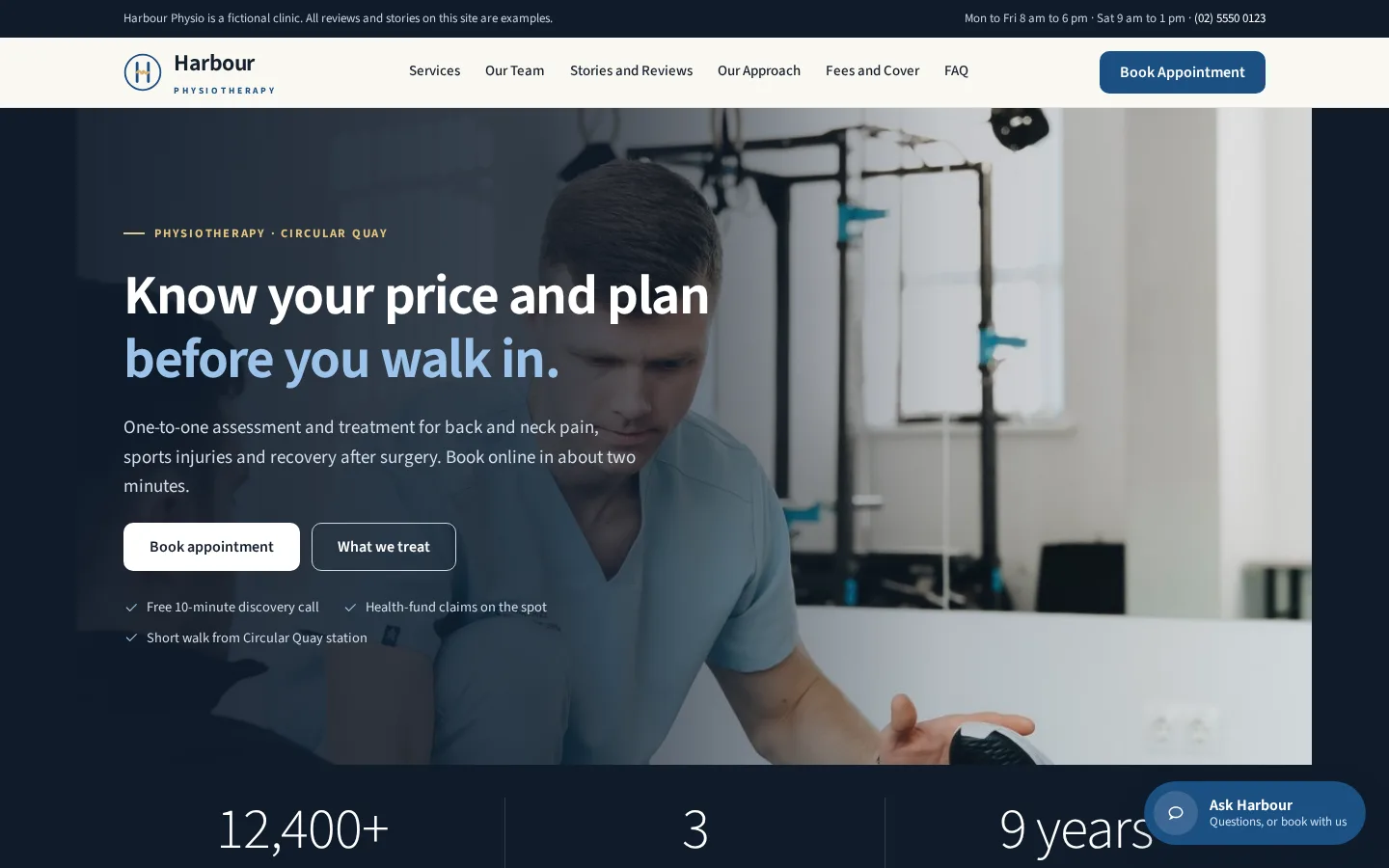
Home page of the Harbour Physio demo clinic site, with a clear Book now button
Sample business site

Harbour Physio

A demo clinic site where booking, payment and an assistant grounded in the clinic's own documents share one flow.

  • Consistent, thoughtful design across every page, the chat and the phone
  • Clear information, so visitors see prices and next steps before they book
  • SEO, AEO and GEO built in, so search engines and AI tools can read and cite it
  • Live calendar booking with deposits or full payment, and automatic reminders
  • Assistant that answers with citations and books inside the chat
  • Private monitoring page showing what the chat and bookings are doing

Projects

My own projects, with live links where they exist.

See more on GitHub
01 · Public data product

NAPAS Jakarta

A live Jakarta air-quality map with an assistant that answers questions from monitor readings, free for everyone as a public good.

02 · Hobby project

ServersUp

A live status board for World of Warcraft and Final Fantasy XIV realms, plus a Discord bot that reports server status and alerts your channel the moment a server goes down.

Experience

Jul 2026to presentSoutheast Asia

GenAI Engineer, GenAI startup

I design and build enterprise AI applications at an early-stage startup in Southeast Asia, turning fast-moving GenAI tools into software that businesses can rely on. I work closely with users to build what actually helps.

Nov 2024to Jan 2026Jakarta, Indonesia

Software Engineer II, Traveloka

I helped keep the systems that bring in inventory from more than 70 partners running reliably, at over 50 million updates a day. I redesigned how the platform connects to partners, so new ones could be added in about half the time, and delivered three major partner integrations on schedule. I also mentored three junior engineers.

Aug 2023to Oct 2024Westborough, MA

Software Engineer, SpotBus

I developed a cost-effective, real-time alert system across hundreds of IoT devices for a school-bus optimization SaaS startup. When incidents like breakdowns, crashes or route changes happen, parents and school administrators are notified within 3 seconds, and a detailed report follows in under two minutes. This was crucial to establishing a working relationship with a critically important enterprise client.

2019to 2022Internships and research

Earlier experience

Between 2019 and 2022 I completed four software internships and research roles at Traveloka, UMass Amherst, MITRE and Constant Contact. I built a full-stack research application for repeated 200+ person studies in semantic query construction, turned COVID-19 and socioeconomic data into insights on vaccine uptake alongside a public-health expert, and built tools that helped engineering teams test and process data faster.

Education and certifications

Graduated May 2023
Amherst, MA

Master of Science in Computer Science

University of Massachusetts Amherst. Coursework included advanced data structures and algorithms, distributed databases, and distributed operating systems and systems.

Graduated May 2020
Amherst, MA

Bachelor of Science in Computer Science

University of Massachusetts Amherst. As an undergraduate, I was credited as a contributor to SQuID, a UMass Amherst database research project on discovering query intent from examples.

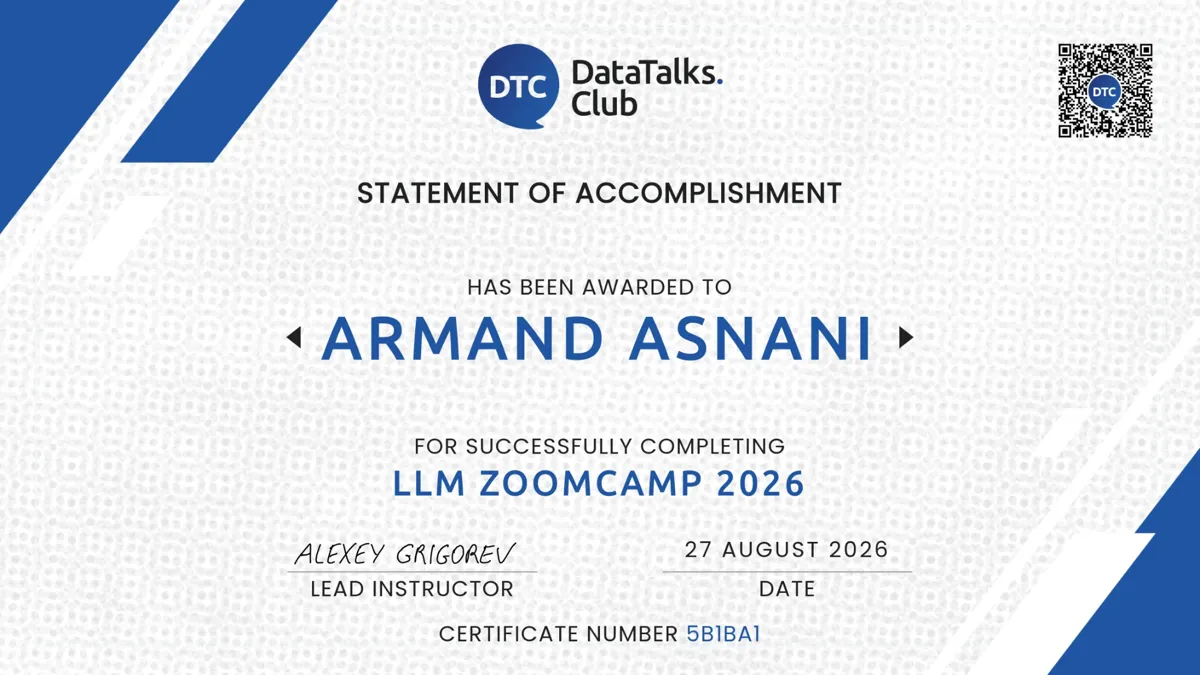
27 August 2026
Certificate 5B1BA1
Certification

LLM Zoomcamp 2026

Statement of accomplishment from DataTalks.Club for successfully completing the LLM Zoomcamp.

LLM Zoomcamp 2026 statement of accomplishment from DataTalks.Club
Contact

Have something to build, fix or decide?

Use Get in touch at the top to pick a free 30-minute slot, or skip the call and email me. We will talk through what you are trying to do and whether I am the right person to help. No obligation.

Email me at inquiries@armasn.dev

What happens on the call

  1. You tell me your issue and requirements.
  2. I evaluate whether it is feasible and, where I can, give you an estimate of time, cost and a possible start date.
  3. If you are interested, I send a proposal to sign, and we get started on the agreed date. If you would rather have advice first, we book an hourly consultation for a later date, with a written recommendations document.

What happens in a consultation

  1. After your free discovery call, we book a session for a later date.
  2. You share your issue, and we talk it through, freeform. Topics include AI tooling, AI strategy, getting the most from AI, and engineer training.
  3. I work to understand it and evaluate the options with you.
  4. Afterwards you get a written report with my suggestions and recommendation. Sometimes I send a proposal too, depending on what fits.